


Research Center for Astronomy & Applied Mathematics · Academy of Athens

COSMOSRelativistic astrophysics in the cosmos

Compact Objects · Strong Magnetized Outflows & Simulations

How does a black hole power the transient sky? We follow magnetic flux from the event horizon out to the jet with general-relativistic magnetohydrodynamic simulations, and connect jets, magnetically arrested disks and plasmoid flares to the tidal disruption events, gamma-ray bursts and radio transients that telescopes record.

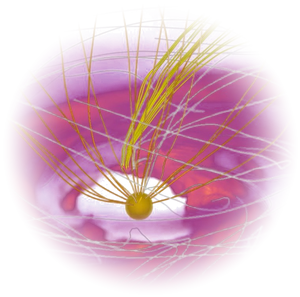
BHAC · 3D magnetized torus
jet field lines breaking out
Research themes

One accretion flow, many transients

Positions along a single axis: how much magnetic flux sits on the horizon. Where a black hole lands on that axis decides whether it ticks, flickers, erupts or shuts its own accretion off.

The group

Einstein’s gravity, magnetic fields and the light we detect

COSMOS, led by Antonios Nathanail, is a relativistic astrophysics group at the Research Center for Astronomy and Applied Mathematics (RCAAM) of the Academy of Athens. We study compact objects, black holes and neutron stars, threaded by strong magnetic fields, the outflows they launch, and the simulations that connect them to what telescopes and gravitational-wave detectors observe.

Our simulations run with the Black Hole Accretion Code (BHAC) in ideal and resistive GRMHD, followed by radiative post-processing. We study how spinning black holes extract energy through the Blandford–Znajek process, how magnetic reconnection breaks current sheets into plasmoids, and how these engines write the light curves of tidal disruption events, GRB jets and Sgr A* flares.

Institute
RCAAM, Academy of Athens
Methods
GRMHD & resistive GRMHD · ray tracing · physics-informed ML
Sources
TDEs · GRB 170817A · Sgr A* · long-period radio transients
Funding
OSCARS (Horizon Europe) · H.F.R.I. / ΕΛΙΔΕΚ (GWcosmos) · European Union
Supported by ΕΛΙΔΕΚ, Hellenic Foundation for Research and Innovation OSCARS, Open Science Clusters’ Action for Research and Society Funded by the European Union
Research

Powering the transient sky

Jets, magnetically arrested disks and the erratic engines of black hole accretion, five ways one accretion flow becomes a nuclear transient.

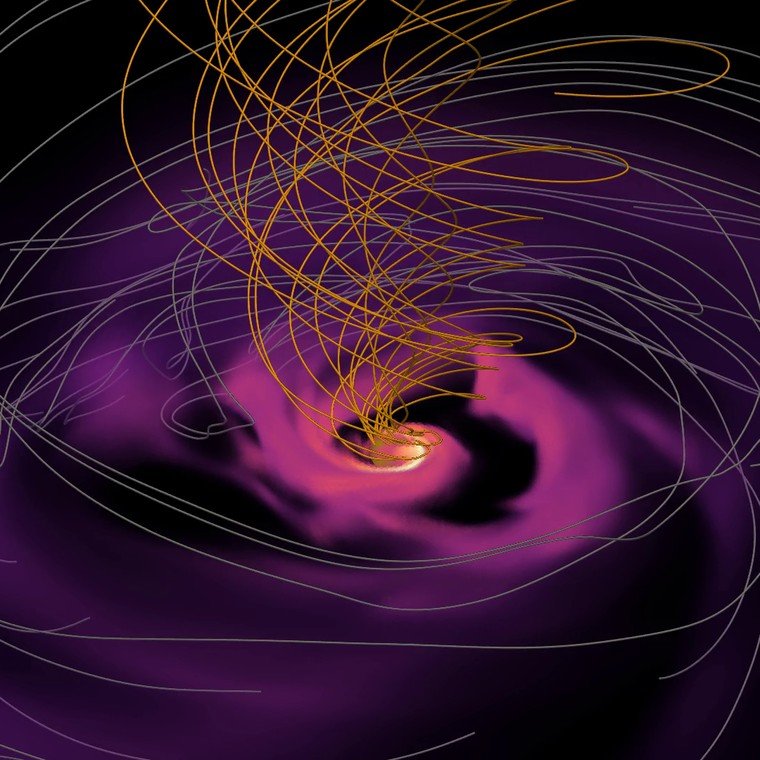
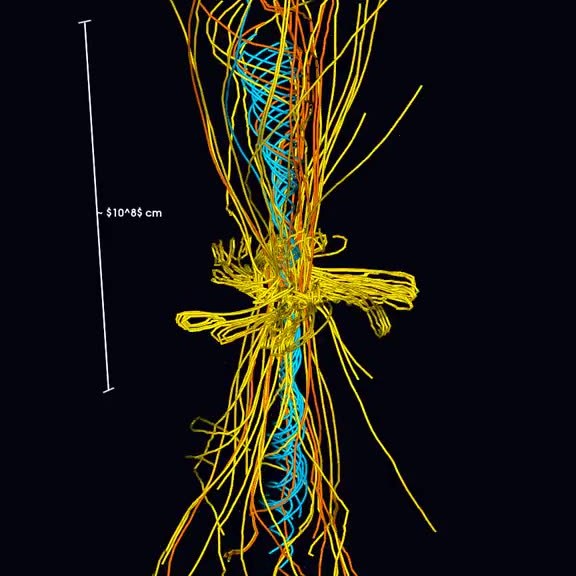
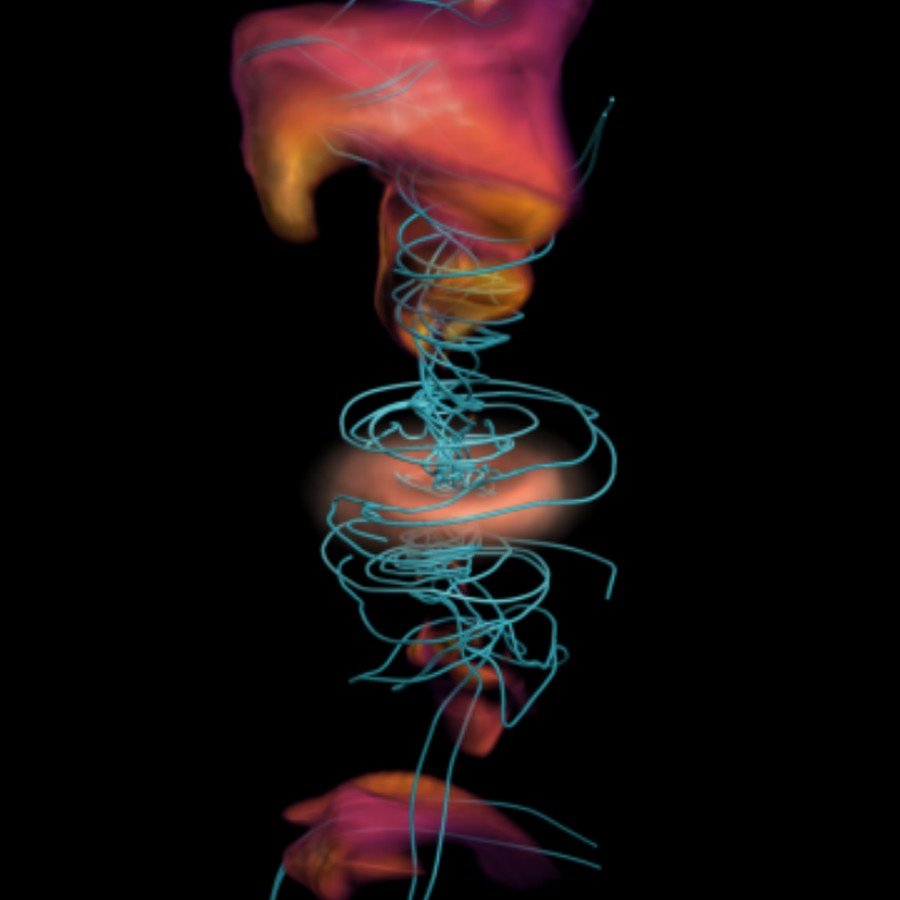
3D GRMHD render of an accretion flow launching an outflow from a spinning black hole
Tidal disruption events

Launching a mildly relativistic outflow

How does a spinning black hole launch a mildly relativistic outflow? Our 3D general-relativistic MHD simulations of accretion flows threaded by magnetic loops of alternating polarity, at black-hole spins a = 0, 0.5 and 0.9, expel discrete, sub-relativistic ejections, a mechanism that could be responsible for the delayed radio counterparts of tidal disruption events.

Spin is necessary: the non-rotating run drives no unbound outflow, while both rotating runs expel ejections through 50 rg roughly every 500 M. The alternating polarity keeps the horizon flux from saturating and fills the disk with current sheets. The outflow is driven thermally and kinetically rather than magnetically, which bounds its terminal velocity at β ≤ 0.21.

Nathanail 2026, to be submitted
Resistive GRMHD

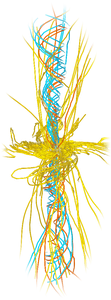
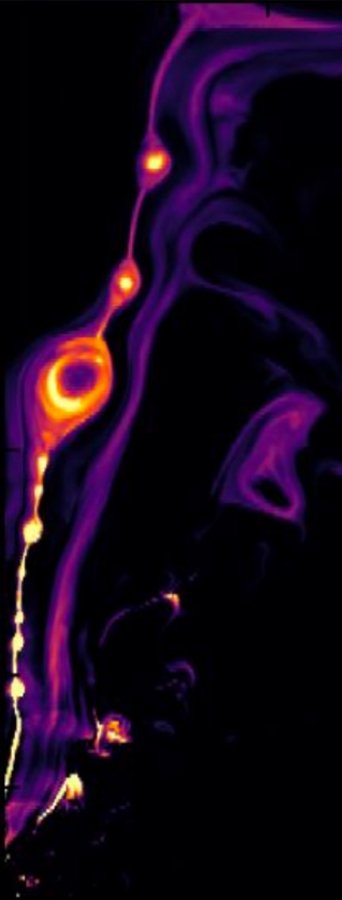
A flux eruption in a resistive magnetically arrested disk.

Magnetically arrested disks

When the flow chokes on its own field

Push poloidal flux inward and it eventually pushes back: flux piles up on the horizon until magnetic pressure balances the infalling gas, and accretion leaks through only in clumps. In 3D the flow never arrests completely, interchange instabilities keep feeding a persistent jet at η ≈ 140%.

Feed the disk alternating magnetic loops and it migrates between arrested states as loops reconnect near the horizon. Even an arrested funnel is not static: flux builds until it reorganizes in a burst, and the jet stutters.

Nathanail et al. 2026, in preparation

3D GRMHD

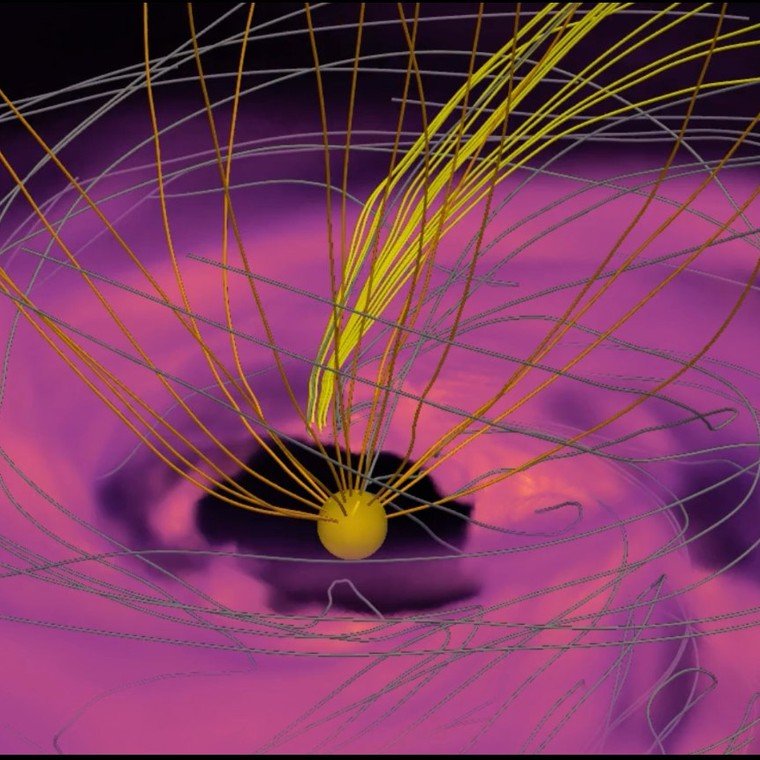
Magnetic field lines of a relativistic jet breaking out of the matter ejected in a binary neutron-star merger.

Gamma-ray bursts

Jet break-out and the structure of GRB jets

Three-dimensional GRMHD simulations follow a magnetized jet as it propagates through the ejecta of a binary neutron-star merger. The outflow that breaks out has a hollow core of about 4° and an opening angle of at least 10°, confirming earlier 2D results, while the ejected matter contributes to the kilonova.

Modelling the non-thermal afterglow of the jet and fitting it to the observations and the superluminal motion of GRB 170817A gives an observer angle of about 35.7°. The same work computes the afterglow of the ejecta itself, and whether the matter behind the thermal kilonova can also produce detectable non-thermal emission.

Nathanail, Gill, Porth, Fromm & Rezzolla 2021, MNRAS 502, 1843

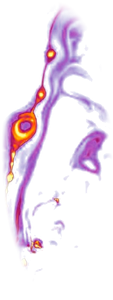
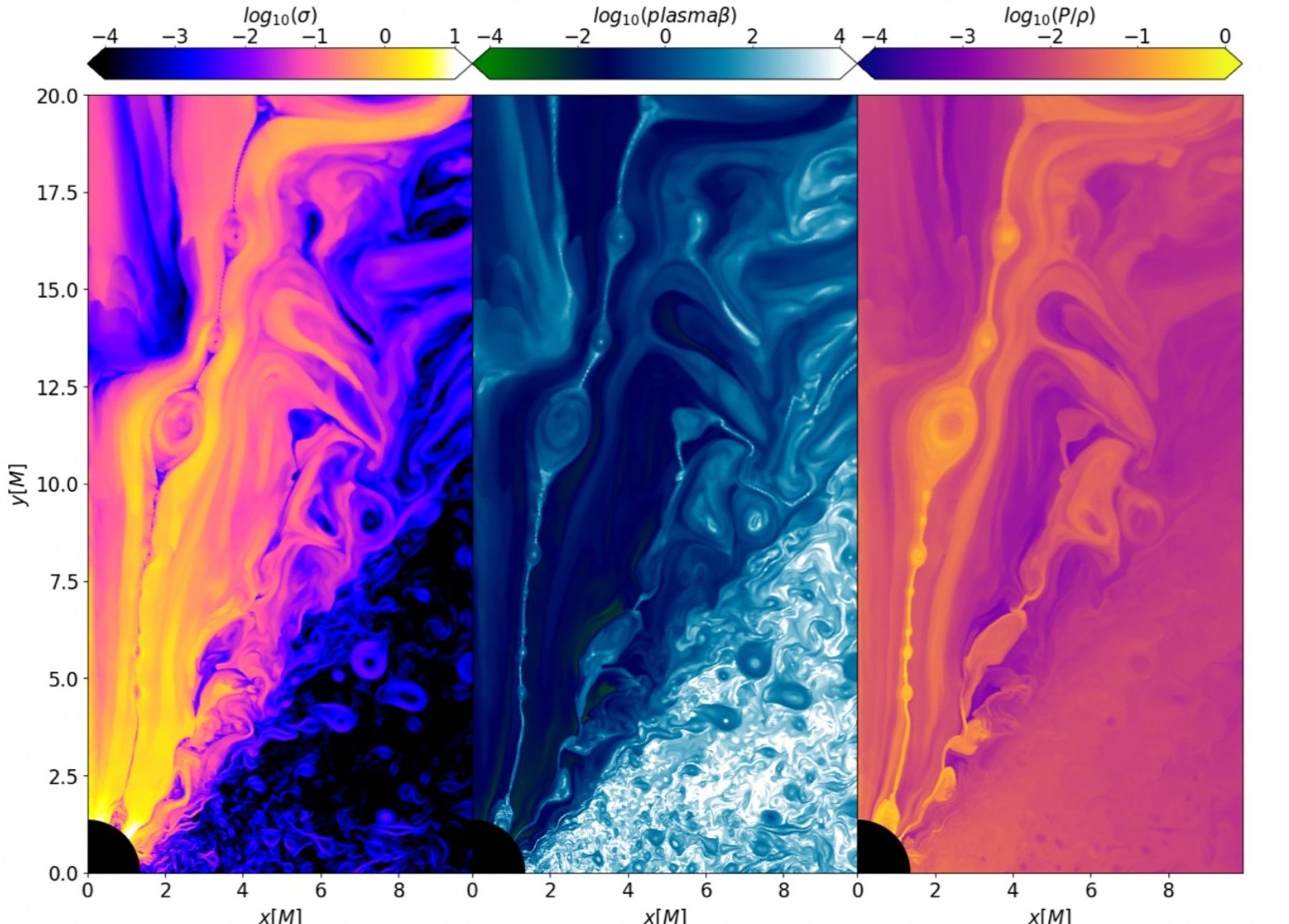
GRMHD · multi-loop Magnetization, plasma beta and temperature maps showing a chain of plasmoids along a current sheet near a black hole

Transient plasmoid formation: magnetization σ, plasma β and P/ρ near the black hole (Dimitropoulos et al. 2025).

Plasmoids & flares

The erratic jet engine

In accretion flows threaded by several magnetic loops, current sheets form between loops of opposite polarity and tear into chains of plasmoids, compact magnetized islands where particles are accelerated.

A SANE multi-loop GRMHD model of Sgr A*, with no stable jet, lets us locate these current sheets and regions of strong magnetic turbulence and compute 230 GHz and 2.2 μm light curves from non-thermal particles. The resulting near-infrared flares match the observed flare durations and spectral index behaviour, linking Sgr A* flares to particle acceleration in plasmoid chains and at the disk boundaries close to the black hole.

Dimitropoulos, Nathanail, Petropoulou, Contopoulos & Fromm 2025, A&A 696, A36 · Nathanail et al. 2020, MNRAS 495, 1549

Simulation

Accretion rate, horizon flux and jet efficiency as the flow crosses into the SUPER-MAD state.

Extreme transients

The SUPER-MAD state

Drive more flux through the funnel than a standard MAD can hold and magnetic pressure governs the entire inner flow. Ṁ onto the horizon collapses by orders of magnitude while the jet power barely moves.

Sustained for about 10,000 dynamical times, this magnetically arrested state globally suppresses accretion, and the jet power exceeds the energy supplied by accretion by more than a factor of 100, an efficiency not reached in earlier simulations.

Nathanail 2026, Black hole limits redefined: extreme efficiency in black hole jets · arXiv:2602.22824

Animation

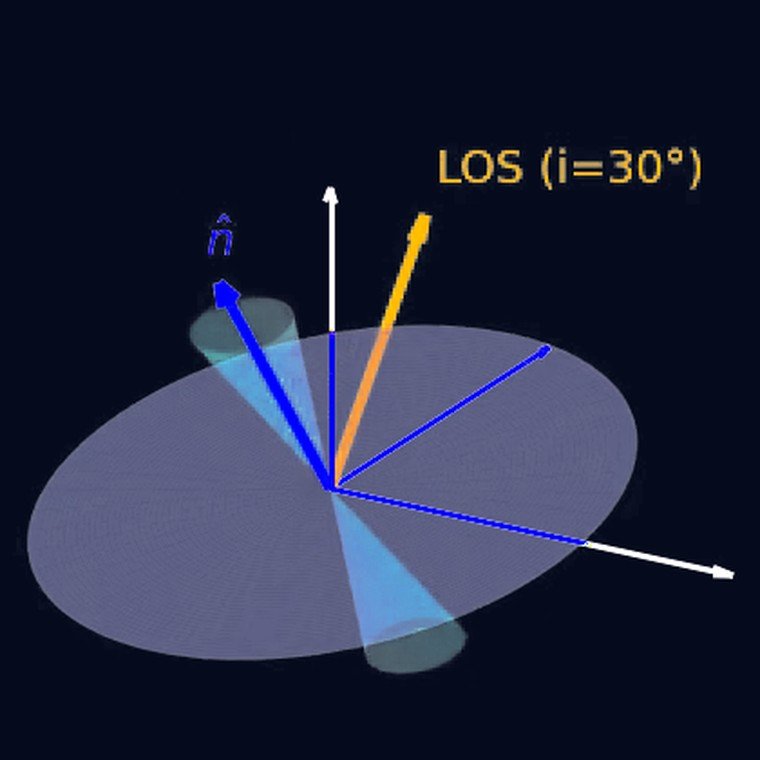
Lense–Thirring precession of a tilted jet (i = 30°) and the periodic light curve it writes.

Precessing IMBH jets

Long-period radio transients

ASKAP J1832−0911 pulses in radio and X-rays for two minutes every 44 minutes, too slow for an ordinary pulsar, too regular to be random flaring. Tilt a jet away from the black hole spin axis and frame dragging makes it precess like a slow gyroscope; every sweep across our line of sight is a pulse.

With the Lense–Thirring relation m r³ = 1.703 × 10⁸ a an intermediate-mass black hole (M ~ 10³–10⁵ M☉) reproduces the 44-minute period at r ~ 5–30 rg. The period is geometry, not a clock.

Nathanail 2025, A&A 704, A123 · Wang et al. 2025, Nature

Projects & grants

Tools & funded work

Codes

BHAC & resistive GRMHD

2D and 3D simulations of magnetized tori, jets and arrested disks around Kerr black holes, with ideal and resistive physics.

Imaging

Ray tracing & light curves

Polarized ray tracing of hot spots and jets, and multi-frequency radio modelling of tidal disruption events.

Outreach

BRING SPACE

The group’s outreach project, turning the physics of our research into games and events for schools and the public. Read more

OSCARS · Horizon Europe · 2026

MEXANE, Open modelling pipelines to Make Extreme Astrophysical Events NICER

PI · A. Nathanail 24 months · from 1 Mar 2026

Open, FAIR pipelines for modelling X-ray observations of neutron stars and black holes from NICER, combining physics-informed neural networks, MCMC and genetic algorithms.

ELIDEK · H.F.R.I. · Project 23698

GWcosmos, Gravitational Wave Events with Neutron Stars: from Nuclear Physics to Cosmology

PI · A. Nathanail

Funded under the 3rd H.F.R.I. Call for Research Projects to Support Faculty Members and Researchers (Physical Sciences), hosted at the Academy of Athens. The project supports the group’s GRMHD work on jets, arrested disks and extreme black hole efficiency.

People

The team

Postdoctoral researchers

Eirini Batziou

Eirini Batziou

Postdoctoral researcherELIDEK · GWcosmos

BHAC simulations of gamma-ray burst jets.

Ioannis Dimitropoulos

Ioannis Dimitropoulos

Postdoctoral researcherOSCARS · MEXANE

Pulsar magnetospheres with physics-informed neural networks; flares from plasmoids and current sheets with radiation; energy extraction from black holes.

View profile →
Vasilis Mpisketzis

Vasilis Mpisketzis

Postdoctoral researcherELIDEK · GWcosmos

Theory and simulations of gamma-ray bursts and accretion; jet dynamics and afterglows in binary neutron-star mergers.

Dimitris Skiathas

Dimitris Skiathas

Postdoctoral researcherOSCARS · MEXANE

Pulsar and neutron-star magnetospheres. Two years at NASA Goddard simulating the magnetospheres of merging neutron stars; PhD completed in 2026.

PhD students

Eleni Antonopoulou

Eleni Antonopoulou

PhD studentMember of the EHT CollaborationLeventis fellowshipProject administrator · BRING SPACE

Flux eruptions in magnetically arrested disks as the origin of Sgr A* flares, with hot spots moving along magnetic flux tubes.

Foivos Zanias

Foivos Zanias

PhD studentELIDEK · GWcosmos

Numerical methods in BHAC: implementing the conservative-to-primitive (con2prim) inversion and searching for extreme solutions.

Spiros Rigas

Spiros Rigas

PhD student · CollaboratorOSCARS · MEXANE

Master’s students

George Karydianakis

George Karydianakis

Master’s student · ΔιπλωματικήOSCARS · MEXANE

Physics-informed neural networks for black holes, supervised by Ioannis Contopoulos.

Undergraduate interns

Panagiota Keranopoulou

Panagiota Keranopoulou

Intern · Πρακτική άσκηση
Ioannis Riganas

Ioannis Riganas

Intern · Πρακτική άσκησηCompleted August 2026

Visitors

Ramandeep Gill

Prof. Ramandeep Gill

Visiting professorOSCARS · MEXANEJune–July 2026 · 10 days

Instituto de Radioastronomía y Astrofísica (IRyA), UNAM, Morelia, Mexico. Here we collaborate on gamma-ray bursts, relativistic outflows and their emission.

Stamatios Stathopoulos

Stamatios Stathopoulos

Short-Term Scientific Mission (STSM)COST Action · EXPAND

Researcher

Antonios Nathanail Antonios Nathanail, the other side
Group leader

Antonios Nathanail

Antonios is a relativistic astrophysicist at the Research Center for Astronomy and Applied Mathematics of the Academy of Athens. He studies black hole magnetospheres, relativistic jets and magnetic reconnection with GRMHD simulations, linking them to gamma-ray bursts, Sgr A* flares and tidal disruption events. He previously worked at the Institute for Theoretical Physics of Goethe University Frankfurt, and is a member of the Event Horizon Telescope Collaboration.

More info
  • PI · MEXANE OSCARS
  • PI · GWcosmos ELIDEK
  • Coordinator & PI · BRING SPACE

Interested in joining? Internships, master’s theses and PhDs: see student projects.

Publications

Selected papers

A selection of work. The complete, up-to-date record is on the databases below.

Work in progress

2026 · to be submitted

AT2020vwl: two ejections, not a collision

Radio modelling of 129 flux densities (0.65–16.6 GHz) favouring two independent outflows from a flux-driven engine. Nathanail 2026

2026 · in preparation

Flux eruptions in resistive MADs

How arrested funnels reorganize in bursts, and the speed ceiling (β ≤ 0.19) the engine sets for its own outflow. Nathanail et al. 2026

2026

Multi-loop accretion & plasmoid chains

How alternating-polarity loops drive MAD transitions and fragment current sheets into plasmoids. Loules, Nathanail & Contopoulos 2026

Selected publications

Outreach · led by the group

BRING SPACE

Our outreach project brings the physics we simulate, gravity, orbits, black holes and space weather, to schools and the public, as games that run in any browser and live events at the Academy of Athens.

Poster · select to enlarge
Event

Researchers’ Night 2026

Friday 25 September 2026 · 17:00–21:00
Academy of Athens, Panepistimiou 28, Athens · free entry

BRING SPACE opens the Academy of Athens for European Researchers’ Night, with simultaneous events in Patras, Ioannina and Lamia. This year’s event is dedicated to 30 years of Marie Curie actions. Expect astrophysics games, VR tours of galaxies, radio astronomy, 3D-printed jets and black-hole disks, and talks by researchers.

  • 18:00Eruptions on the Sun · Kostis Gontikakis
  • 19:00Surfing the waves of spacetime · Nikos Karnesis
  • 20:00The world of galaxies · Panos Patsis

All evening: experiments, astrophysics & VR games, Zooniverse citizen science, 3D prints and radio observing with the Gerrei Educational Antenna.

Programme
Minigames

Two missions to play

Self-contained, offline-capable and free of trackers, ready for a classroom with bad wifi.

MSN-BH

Torch Academy

Light gems around a black hole. Learn how gravity bends your beam and match redshifted colour, before Earth ages without you.

MSN-OD

OrbitGuard Academy

Fly satellites around Earth, find out why a lower orbit is a faster one, and clear debris before a Kessler cascade.

Event

Researchers’ Night at the Academy

25 September 2026, 17:00–21:00 at the Academy of Athens: stations in the gardens, talks in the main hall. Poster & programme

Classrooms

Bring Space for Schools

A delivery plan to package the games for school learning platforms, no pupil accounts, no personal data.

BRING SPACE is funded by the European Union Funded by the European Union
Contact

Get in touch

For collaborations, student projects, talks or BRING SPACE school visits, write to the group leader.

Address

Research Center for Astronomy & Applied Mathematics

Academy of Athens
Soranou Efesiou 4
115 27 Athens, Greece

Email

Group leader · A. Nathanail

anathanail@academyofathens.gr

Profiles

Find the work

Google Scholar · NASA ADS · INSPIRE (RCAAM) · LinkedIn

Student projects

Work with COSMOS

We offer projects at every level. Send a short email with your background, your level of studies and the topic that interests you.

Πρακτική άσκηση

Undergraduate internship

A few months inside a research group: learn to run and visualize simulations, and analyse real data.

Διπλωματική εργασία

Master’s thesis

A focused research question with its own simulations or models, written up as a thesis.

Διδακτορικό

PhD

Several years of original research towards publications, conferences and international collaborations.

Topics

Black holes

Spinning black holes, their magnetospheres and how they extract energy to power jets.

Black hole imaging

Ray tracing of accretion flows and jets, the images and light curves of Sgr A* and M87*.

Black hole simulations

General-relativistic MHD simulations of accretion disks, magnetically arrested flows and plasmoids.

Extreme relativistic explosions

From stars to black holes: gamma-ray bursts, tidal disruption events and neutron-star mergers.